What Odysseus’s hosts knew about wealth that your bank doesn’t
Prefer to listen? An AI-narrated audio summary of this essay is available below
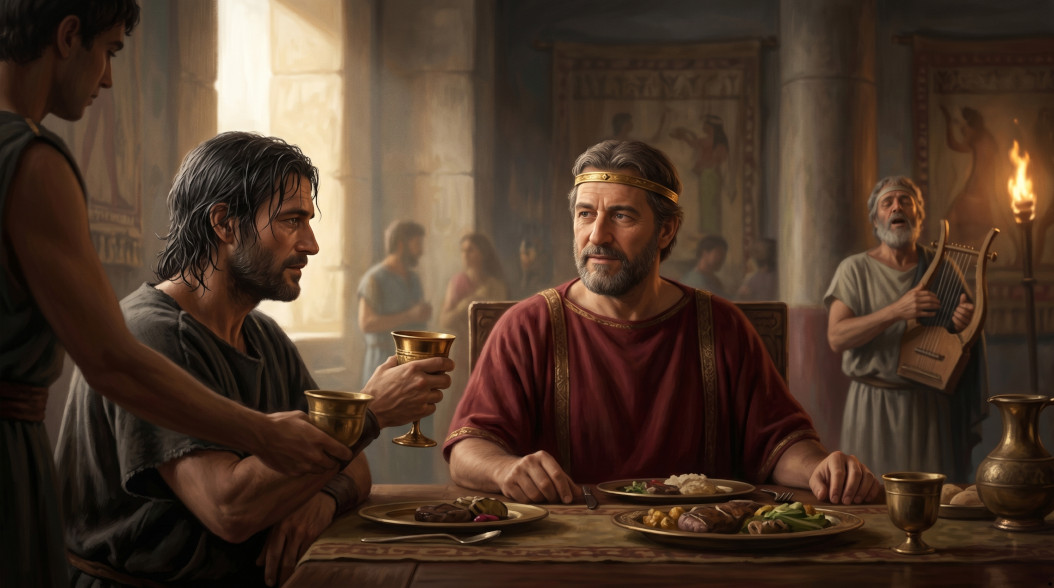
In the sixth book of the Odyssey, Odysseus arrives at the court of the Phaeacians as a shipwrecked stranger: soaking wet, nameless, without rank or visible status, nothing that would justify special treatment. King Alcinous welcomes him, feeds him, clothes him, organizes athletic games and a banquet with a bard in his honor. Only after all of this — food, wine, music, gifts — does he ask who the stranger is.
The order is the inverse of what any rational economic logic would require. Give first, ask later. Create the bond first, then establish with whom.
That scene is three thousand years old. And yet it describes with surgical precision something capitalism has destroyed — something we still sense the absence of without being able to name it.
Give first, ask later
The institutional form governing that banquet is called xenia: sacred hospitality, the code regulating relations between those outside the bonds of clan and kinship. In the Odyssey, xenia is not a pleasant custom — it is a cosmic structure. Every stage of Odysseus’s journey — from the court of Nestor to that of Menelaus, from the island of the Phaeacians to the palace of Ithaca — is organized around its norms, and their violation produces consequences that shake the order of the world. The suitors who consume Odysseus’s resources without being legitimately invited as guests, the Cyclops who eats guests instead of nourishing them: these are the great crimes of Homeric epic — not murder or theft.
But it must be said immediately: xenia is not universal moral ethics. It is an aristocratic code between equals — or between those who might become equals. The stranger welcomed is someone worth building a relationship with; someone who carries Zeus’s protection, but also a potential for alliance. The gift obligates: it creates bonds, but also hierarchies, dependencies, debts that are difficult to dissolve.
In this sense, the modern contract did not emerge only as a loss — it also emerged as emancipation. As liberation from permanent personal relationships that bind as much as they protect. This is where the real tension lies, the one the Homeric world never resolved and modernity tried to cut with the blade of the market: in the world of the gift, no one is truly independent; in the world of the contract, no one is truly bound. Modernity chose the second path because it feared the first.
The spoils of war are not property
Jean-Pierre Vernant, in his fundamental study Myth and Thought Among the Greeks, showed how wealth in the Homeric world is not conceived as capital to invest in producing more capital, but as goods to distribute for affirming one’s rank and weaving alliances. The Homeric hero accumulates not to keep but to give: generosity is a cardinal virtue, and the miser is a morally repugnant character. The treasures kings hold in their great halls are not prudential reserves for hard times — they are the potential for gift, the raw material of future social relationships. A rich king is one who has much to give; and giving much is proof of his rank.
This explains why the conflict between Achilles and Agamemnon — the one that opens the Iliad — would be fundamentally misread as a property dispute in the modern sense. Agamemnon must return Chryseis to her father, a priest of Apollo, and to compensate himself takes Briseis, Achilles’ war prize. He doesn’t steal a possession — he publicly denies Achilles the recognition of his value. The spoils of war are not private property: they are visible honor, the material translation of rank and warrior worth. To take them is a cosmic humiliation, not a patrimonial injury.
All the difference in the world lies in this distinction. In the Homeric world, there is no category of the alienable object, separated from its possessor and exchangeable on a market between anonymous subjects. Every thing carries with it the history of who produced it, conquered it, received it as a gift. Things are not neutral: they are traces of relationships.
The contract is a machine for forgetting
The modern contract works in exactly the opposite way. Its purpose is not to create bonds but to close them: the moment the price is paid and the goods delivered, seller and buyer return to being two separate individuals, free from any mutual obligation. Of course, no real market functions without residues of trust, reputation, and non-contractual cooperation. But the ideal logic of mercantile exchange tends to neutralize these relationships, reducing every transaction to an isolated episode, without history and without future, between interchangeable subjects.
This anonymity is not a dysfunction: it is precisely what the market requires to function, and it is also what makes it extraordinarily powerful. It allows complete strangers to cooperate without knowing each other, without trusting each other, without belonging to the same clan. It is a loss of relational density — but also an enormous gain in social scalability. The baker who sells me bread this morning has no obligation to me tomorrow, nor I to him. And precisely because of this, I can buy bread from someone I don’t know, in a city that isn’t mine, without anyone being accountable to anyone.
The price of this freedom is that things lose their history. The moment an object enters the market as a commodity, it loses every trace of the relationship that produced it. Its value is its price, not its origin. And when things lose history, people lose it with them.
The gift has memory
There is a scene in the Iliad that illustrates this logic with a precision no theoretical essay could match. Glaucus and Diomede, two warriors from opposing sides, meet on the battlefield. They are about to fight. Then they discover they are hereditary guests: their ancestors had exchanged gifts generations before. They do not fight. Instead they exchange armor, sealing a bond that even military hostility has not erased.
This is not a marginal episode. It is the demonstration that in the Homeric world, the gift creates bonds that cross time, generations, even war. The relationship established through xenia does not belong to the individuals who contracted it: it belongs to the families, the clans, the lineages. It lasts as long as memory lasts.
The market has no such memory. It is, by structure, amnesiac: every transaction is a world unto itself, with no before and no after. Vernant puts it in a formula worth meditating on: in the Homeric world, wealth is “the potential for relationship.” In the world of the market, the relationship is an obstacle to the transaction — a sentimental complication that risks distorting the price.
Efficient and fragile
What is lost, then, when the contract replaces the banquet? Not simply bonds — capitalism does not eliminate them, it displaces them. It relegates them to the private and sentimental sphere, while the market occupies public space. Fewer and fewer spaces remain for non-accountable obligations: hospitality, loyalty, gratitude, symbolic debt, care.
The point is not that we should return to Homer — that world had its own cruelties, its pitiless hierarchies, its impossible debts. The point is that no society survives for long if contractual logic completely colonizes the spaces of the gift. Because the contract can coordinate interests, but it struggles to produce belonging. And a society without belonging becomes something very precise: maximally efficient and deeply fragile at the same time.
Next: Marcel Mauss and the gift — the French anthropologist who proved that the Homeric world wasn’t an anomaly. It was the norm for most of human history.
Further reading
Homer, Iliad, trans. Robert Fagles, Penguin Classics, 1990.
Homer, Odyssey, trans. Emily Wilson, W.W. Norton, 2018.
Jean-Pierre Vernant, Myth and Thought Among the Greeks, Routledge, 1983.
Leave a Reply