What a Bronze Age hero’s refusal tells us about the soul capitalism reorganized
Prefer to listen? An AI-narrated audio summary of this essay is available below
An impossible offer
There is a moment in the Iliad that should stop every economist cold.
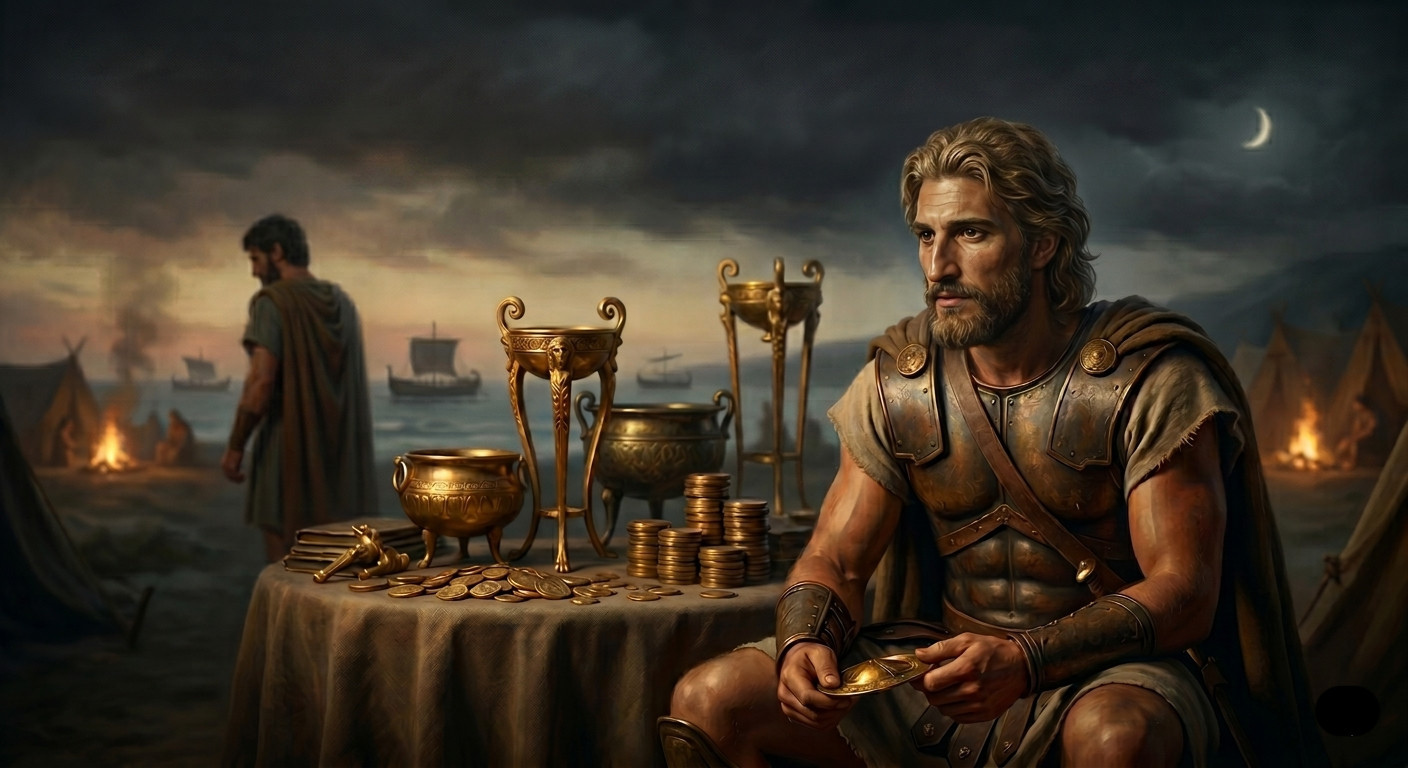
It is night. The Greek army is losing. Agamemnon, desperate to end his feud with Achilles — the greatest warrior on the field — sends three envoys with an offer of breathtaking generosity: seven gold tripods, ten talents of gold, twenty gleaming cauldrons, twelve prize-winning horses, seven women of Lesbos skilled in fine work (weaving, spinning, the management of a household). And more: twenty Trojan women once the city falls, a choice of his daughters in marriage with a royal dowry, and — if the gods allow the sack of Troy — a ship filled to the brim with gold and bronze, as much as Achilles desires.
It is, by any standard, an extraordinary offer. Achilles himself doesn’t dispute this. He calls it generous.
He refuses anyway.
Not with rage, not with wounded pride — but with something more unsettling: a calm, philosophical dismissal of the entire logic behind the offer. Because that offer, for Achilles, is already wrong in its premise.
The problem, Achilles explains, is not the quantity of treasure. It is the nature of the reasoning that produced it. In that system, wealth measures a man’s worth — and therefore can compensate it, repurchase it, make it even. But for Achilles, this is precisely the unbearable point. “Equal share falls to the man who hangs back and to the man who fights hard”: if courage and cowardice receive the same reward, value doesn’t exist — only price does. And price is exactly the category Achilles refuses.
Agamemnon made the wrong offer because he operates inside the wrong system of values.
What he is actually refusing
To understand why, we need to be precise about what Achilles is refusing.
This is not the story of a pure, pre-economic hero rejecting the corrupting power of wealth. The Homeric world was not innocent: it had its hierarchies, its violence, its brutal competitions for status. The tripods, the horses, the women are not money in any modern sense. They are signs of redistributed honor, tokens of prestige in an economy organized around reputation and rank. When Agamemnon stripped Achilles of Briseis at the start of the poem, he didn’t steal property — he publicly reduced Achilles’ visible status, which in that world amounts to the same thing.
What Achilles refuses, then, is not wealth as such. He refuses a system in which his value can be arbitrarily reduced by whoever holds institutional power — repurchased, compensated, made fungible. He refuses the logic that says his worth has a price.
Kleos — the value that cannot be bought
Where Achilles actually lives is in kleos: glory, the immortal name that outlasts death. But kleos is not simply “fame.” It is social memory made durable — a form of value that cannot be accumulated privately, that exists only insofar as it is recognized by others and transmitted through time. In contemporary terms, it is closer to symbolic capital than to money. And crucially, it is not transferable. No one can give you kleos. No one can take it away by decree. Agamemnon can strip Achilles of Briseis. He cannot strip him of what he has done.
His mother Thetis has delivered a prophecy with the cruelty of absolute certainty: stay at Troy, die young, be remembered forever; go home, live long, be forgotten. The treasure Agamemnon is offering doesn’t appear in this equation because it belongs to a completely different register of value. To choose a long, obscure life in exchange for Agamemnon’s gold would be, in Homeric logic, to sell one’s identity at market price.
Why it seems alien to us
We find this choice alien. That’s the point — but it requires some care.
When classical economics constructed the figure of homo oeconomicus — the rational agent who maximizes utility, who trades time for money, who measures success in accumulation — it was not describing a universal human nature. It was constructing a type. Adam Smith himself knew this: his Theory of Moral Sentiments is full of sympathy, honor, and the need for social approval. The desire for recognition that drives Achilles is not so different from the desire for respect that Smith identified as a fundamental human motivation.
What changed was not human nature. What changed was the institutional framework that channels these motivations — and the range of choices that framework makes thinkable.
The motivations that never disappeared
This is the sharpest point Achilles delivers across three thousand years: what we consider “rational” depends entirely on the system of values we inhabit. The capitalist system — organized around accumulation, linear time, and the convertibility of all value into price — did not eliminate the motivations that drove Achilles. It reorganized them. The desire for kleos resurfaces in the pursuit of fame, in social media visibility, in the hunger for cultural recognition. The logic of the gift survives in academic prestige, in volunteering, in the moral economy of open-source software. Even sacrifice — the deliberate destruction of what one possesses — reappears in the extreme self-abnegation of certain careers, rerouted toward different ends.
The question, then, is not “when did we stop inhabiting that world?” That world never disappeared. The question is more precise: in which spaces do we still inhabit it without recognizing it? And who decides, today, what counts as value — and through which mechanisms?
A reorganized field of forces
The Iliad Book Nine ends with Achilles confirming his refusal and announcing he will sail home at dawn. He won’t. He will fight, die young, and his name will last three thousand years.
He was right, within the logic of his world.
What this series is built around is not nostalgia for that world — which had its own cruelties, its own hierarchies, its own forms of domination. It is something more precise: an attempt to trace how the reorganization happened. How a civilization that for millennia had structured life around gift, glory, cycle, and sacrifice came to structure it around accumulation, growth, linear time, and the permanent convertibility of all value into price.
Not a lost world. A field of forces that was reorganized — and is still being reorganized, right now, in ways that most economic analysis cannot see because it takes the reorganization for granted.
Capitalism did not conquer a pure soul. It inherited a complex one — and rewrote the hierarchy of its values.
That rewriting is what this series traces.
(continues in the next essay of this series)
Further reading
Adam Smith, The Theory of Moral Sentiments (1759), Penguin Classics, 2009.
Homer, Iliad, trans. Robert Fagles, Penguin Classics, 1990.
Jean-Pierre Vernant, Myth and Thought Among the Greeks, Routledge, 1983.
Leave a Reply